Turning vchain’s static brochure site into a lead-gen engine
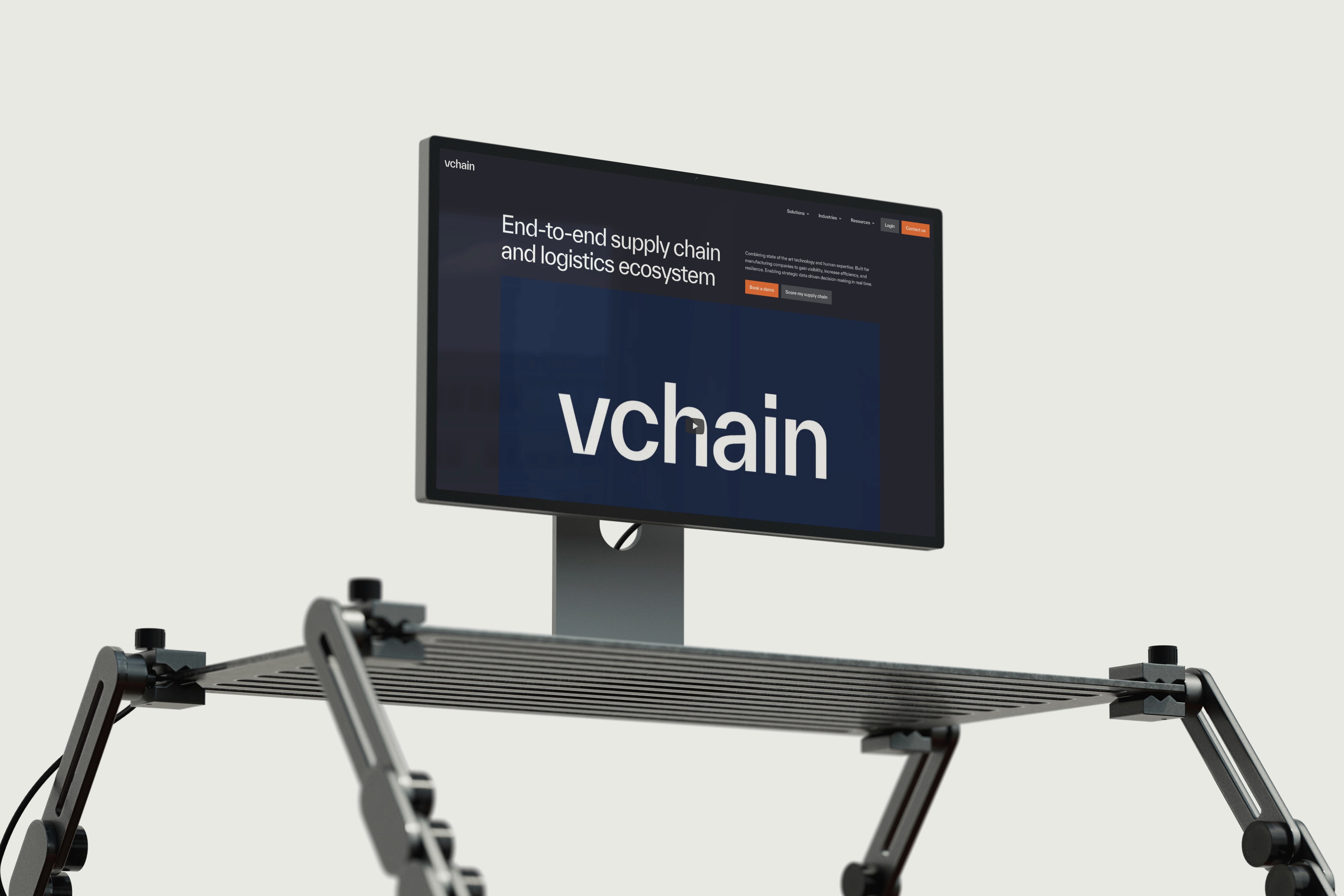
Migrated VChain from Tilda to Framer, repositioned a 40-person supply chain SaaS as an enterprise-grade platform, and wired the site into HubSpot to convert visitors into qualified pipeline.
Overview
vchain came to me with a Tilda "leaflet" of a website: no analytics, no HubSpot, no real way to capture or qualify the pipeline their sales team needed. In about 12 weeks we rebuilt the entire site in Framer, repositioned them from "just another TMS" into a supply-chain analytics platform, and turned the website into a working part of their go-to-market motion.
At a glance
Client | VChain: supply chain analytics & transportation management platform |
|---|---|
Timeline | March 4 – May 25, 2026 (live launch), plus 30-day post-launch support |
Engagement | Fixed-scope project with phase-two sprint work (AI Applications landing page) |
Stack | Framer (build + hosting), HubSpot (CRM, forms, meeting scheduler), Gleesis (DNS) |
The client
vchain is a Stockholm-based SaaS company serving global manufacturers with complex, multi-region supply chains. Their platform sits on top of existing TMS, ERP, and carrier systems: aggregating fragmented data into a single source of truth, layering predictive and prescriptive analytics on top, and pairing it with a control-tower team in Poland that acts on behalf of customers.
They're roughly 40 people, sell into enterprise accounts, and had just made two foundational go-to-market investments before we started: HubSpot as their CRM, and their first dedicated marketing hire.
The website was the missing piece.
The challenge
When Emelie reached out, vchain's site was running on Tilda. In her own words it was a "leaflet": visually flat, structurally patchwork, and disconnected from everything that mattered.
No lead-gen engine. The site didn't connect to HubSpot. Demo requests routed through a Calendly link that Emelie described as "horrendous," and there was no way to track downloads, form fills, or visitor behavior.
Wrong perception. Risk-aware enterprise buyers landed on a site that felt like a 5-person startup, not a credible partner for global manufacturers managing millions in freight spend.
Confused positioning. The solutions dropdown mixed features and services with no clear hierarchy. Prospects searching for "TMS" found them, but couldn't tell that VChain was actually an analytics-first platform that sits above their existing TMS.
No resource hub. Case studies, guides, reports, and product content were scattered or missing entirely. Sales had nothing credible to send a prospect mid-cycle.
AI-generated content debt. Old blog posts were obviously AI-written with AI imagery, actively hurting credibility with the risk-aware buyers they were trying to win.
The CEO and board had signed off on the migration, but Emelie was buying a website for the first time. Her concern was simple: she didn't want to end up with a beautiful site that still didn't do anything.
The approach
We framed the project in three layers: and made the strategy work, not just the pixels, the deliverable.
1. Reposition before redesigning
Before touching design, we ran a Brand Story workshop with Emelie's team to define:
Who vchain actually serves (global manufacturers, not generic shippers)
The real pain (siloed data across regional TMSs, carriers, and ERPs)
vchain's wedge ("TMS on steroids" — one platform that sits over the rest, with prescriptive analytics that tell you what to do, not just what happened)
The proof (up to 20% cost savings, a decade of manufacturing references, a control tower team that takes action on the customer's behalf)
We pulled Tacton Systems and o9 Solutions in as positioning references — companies targeting the same buyer with credible, condensed, role-based storytelling — and structured VChain's narrative to live in that league.
2. Rebuild the site around the buyer, not the org chart
The old site had ~20 nearly identical feature pages. We collapsed them into six solution packages:
Supply Chain Logistics & Analytics
Transportation Management
Supply Chain Transformation
Purchase Automation
Supplier Collaboration
Advisory, Compliance & Trade Management
Each became a single clickable block on a redesigned Solutions page, with hover-revealed descriptions and a clear path into deeper content. Industries pages were kept and tightened. The Resources section was rebuilt as a hub with Blog, Product Resources, Case Studies, Partners & Integrations, and Help Center.
The homepage got the most attention — a new hero that names the problem, an animated globe with logistics hubs, scroll-triggered KPI metrics, a layered "three pieces of one system" visualization (platform + supply-chain-as-a-service + advisory), and a testimonials section pulled high above the fold for instant credibility.
3. Wire it into the revenue engine
The migration only mattered if it produced pipeline. We set up:
HubSpot tracking across every page, with the team granted manager-level access
Lead-capture forms for demo requests, contact, resource downloads, blog signups, and the Logistics Maturity Scorecard
HubSpot meeting scheduler replacing the legacy Calendly link, routing into a real CRM record
Round-robin–ready calendar for the inside-sales team
A Logistics Maturity Scorecard embedded as a lead magnet in the Resources hub
Domain transfer from Gleesis to Framer's hosting was handled with the CTO during the launch week, with SSL and DNS coordinated to minimize downtime.
What we delivered
A complete Tilda → Framer rebuild of vchain.se
New homepage with repositioned hero, KPI metrics, testimonials, and a custom layered offering visualization
Consolidated Solutions architecture (6 packages instead of ~20 feature pages)
Resources hub: Blog, Product Resources, Case Studies, Partners & Integrations, Help Center
Careers page with CMS-driven job postings routing applications to Carl-Henrik
HubSpot form integration across the site
HubSpot meeting scheduler replacing Calendly
Logistics Maturity Scorecard lead magnet
Custom CMS templates for case studies, blog posts, and guides — the VChain team can publish independently
Documentation and training videos for the team to manage copy and content in Framer
30 days of post-launch support
Phase-two sprint: a dedicated AI Applications landing page (separate engagement, scoped after launch)
Outcome
VChain went live on May 25, 2026, three days ahead of the board meeting that drove the deadline. The site that was once a static brochure is now:
Plugged into the CRM. Every form submission, demo request, and resource download flows into HubSpot for the sales team to action.
Credible at the enterprise level. The repositioning around analytics and prescriptive insights closed the gap between what VChain sells and what prospects perceive.
Self-serve for the team. Tucapel and the marketing function are publishing copy, blog posts, and case studies directly in Framer without needing dev support.
Set up for compounding wins. With the foundation in place, phase-two work began immediately on an AI Applications landing page to capture rising demand around AI-powered logistics tooling.
The relationship continued past the original scope — sprint work, conversion rate optimization over the first 30 days, and an ongoing collaboration on new pages and offerings.
If the business has outgrown the website, let’s fix that
If your company is stronger than the site makes it look, I can help you reposition it so prospects trust you faster, understand what you do more clearly, and feel more confident taking the next step.
© 2026 Andru Bailey. All rights reserved.
Now booking for September